A web designer asked a question in r/SEO this week that pulled in nearly a hundred answers: everyone is bragging about launching AI-built websites in five minutes, so am I missing something? We build websites for a living and we use AI every day, so we read the whole thread. The honest answer is that both camps are right about half of it, and the businesses that figure out the middle are going to stand out while everyone else starts looking the same.
What the skeptics get right
The designer who started the thread spent 8 to 10 hours trying to get an AI-built site to match what he pictured, and said most of that time went to fighting generic output in both the design and the copy. Then he timed himself building the same pages by hand and finished in half the time. One commenter put the reason bluntly: out of the box, AI has no taste and no consistency, so it defaults to average, because average is what it was trained on.
We have seen the same sameness problem before. When drag and drop site builders first got popular, the pitch was identical: anyone can build a site, fast and cheap, no developer needed. And people did. Then all those sites started looking the same. Same templates, same sections, same stock feel. They existed, but the entire point of marketing is to stand out, and a website that looks like ten thousand other websites cannot do that job. Pure AI-generated sites are converging the same way, just faster, and visitors are starting to recognize the look.
The sharpest point in the thread was not about design at all. It was about month six. Somebody has to fix a broken form, update the tracking, add a page, adjust the schema, and hand the site to someone who is not a developer. As one commenter said, that is when a boring CMS starts looking like a pretty good idea. A business owner with a folder of AI-generated code and no content management system is one bad weekend away from paying someone to untangle it. Several developers in that thread are already calling this next wave of work AI remediation, and honestly, some of our newest clients are exactly that: people who built an AI site in a weekend, loved it for a month, and then hit the maintenance wall.
What the AI camp gets right
Here is the other half, and it deserves a fair hearing. The most convincing people in that thread were not hobbyists. One agency owner described spending hundreds of hours building AI workflows and now ships fully optimized 15 to 25 page sites in about two days, exporting the result into WordPress. Another built a repeatable process and has sold six AI-assisted sites at real agency prices. What separates them from the five-minute crowd is the same thing in every case: a framework. Brand rules, design references, SEO checklists, and prompts refined across many projects. The intelligence lives in the system, not in a single clever prompt.
That matches our experience exactly. The tools are genuinely good now. Fast, current libraries, clean output. The gap between slop and something excellent is not the AI. It is the operator and the framework the operator brings.
How we build: why not both
We build on WordPress, because after two decades it is still the platform you actually own. Your content, your data, your hosting, portable anywhere, editable by a normal human after handoff. No platform can sunset you or reprice you. If you have read our thinking on key channel risk, you already know why that matters to us.
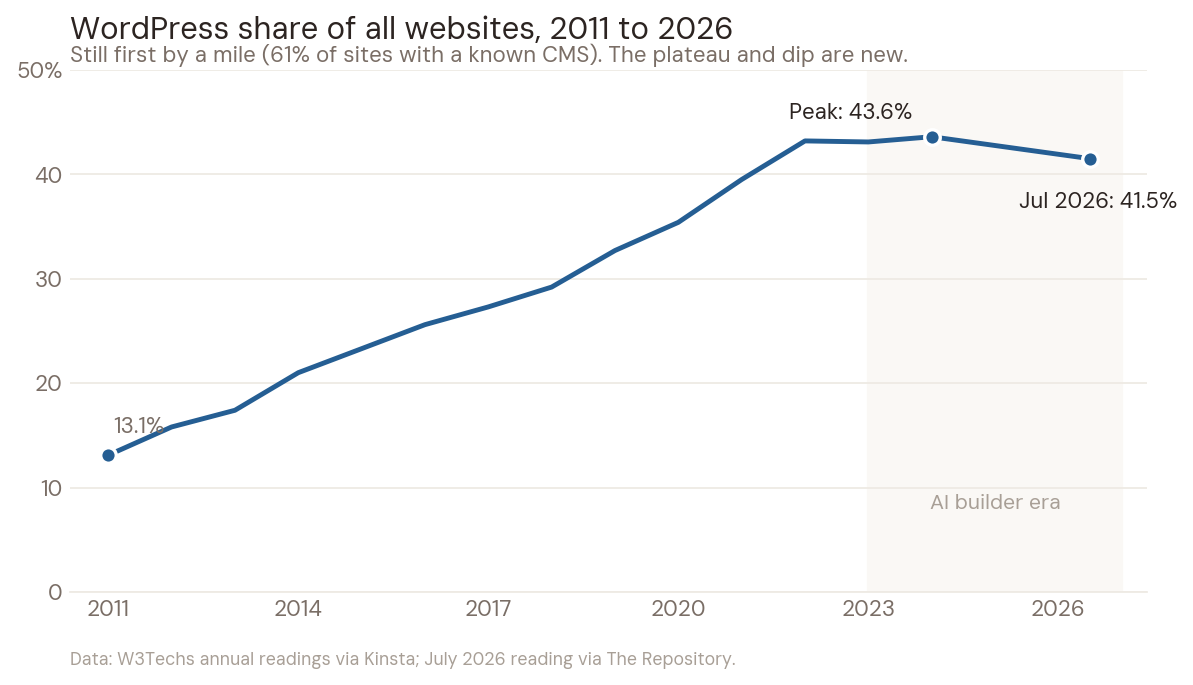
WordPress still runs 4 in 10 of all websites and 61 percent of sites with a known CMS. The plateau since 2022 is the AI era arriving. Data: W3Techs annual readings via Kinsta; July 2026 reading via The Repository.View the data behind this chart
Then we point AI tooling at it. Our team uses AI to draft, build sections, and test far faster than the traditional agency workflow. But everything runs through our own design system, a knowledge base of layouts, patterns, and rules we have refined across every client site we have shipped. That is the ingredient the raw tools do not have. Not rocket science, just a set way of designing things that keeps a site from looking stale or template-made.
The blunt version: a good developer with a 200 dollar a month AI subscription will beat a business owner throwing prompts at whatever tool is trending. Same AI, completely different result, because one of them knows what good looks like and what to reject.
Leave the utility room unlocked
Think about how your building handles utilities. There is a utility room, standard fittings, and any licensed professional can walk in and work on it. You would never let the water company weld the couplings shut so that only their technicians could ever touch your plumbing. Most business owners would call that arrangement crazy. Then they buy a website that works exactly that way: a proprietary system where you pay a subscription just to access your own pages, and no outside developer can touch the pipes.
Everything we build is set up the opposite way from day one. Standard platform, standard tooling, clean structure, so any future developer, employee, or vendor can open the utility room and get to work. No proprietary lock, no ransom subscription, no technical debt bomb waiting for whoever comes after us.
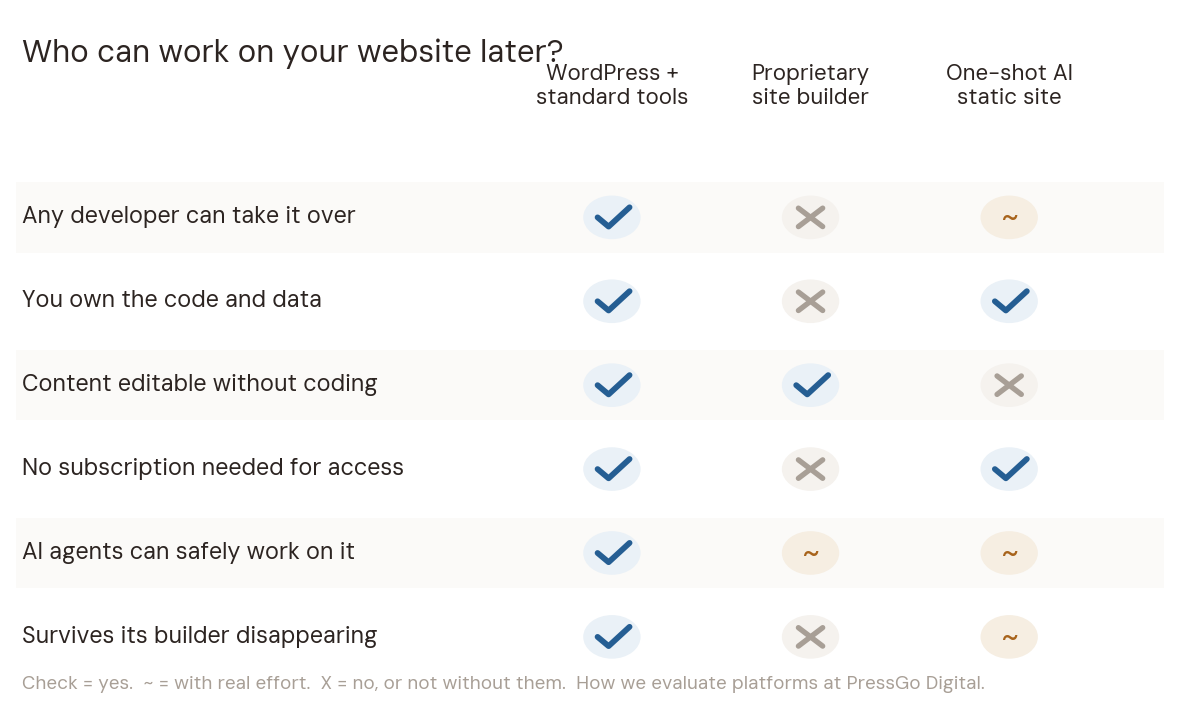
The question that matters in year two: who can work on this site besides the thing that built it? Hover any cell for the reasoning. How we evaluate platforms at PressGo Digital.View the data behind this chart
We would add one more thing to that chart, because it is where this is all heading: the future of WordPress is agentic. Sites that AI agents can safely read, edit, and build on, with a human setting the direction. We believe it enough that we built our own agentic tool for it, PressGo, which lets AI build real WordPress pages in your own site rather than locking you into someone else’s platform. Open foundation, agentic tooling on top. That combination is the whole thesis of this article in one sentence.
So which should you choose?
If you need something online tonight and it just has to exist, use an AI builder and do not overthink it. Plenty of simple businesses genuinely do not need a CMS.
If your website is how customers judge you before they call, and someone other than a developer will need to update it for years, build on a real CMS and use AI to make the build faster and better, not to replace the judgment. That is what we do for our own sites and for every client site we design: fixed quote agreed before we start, free hosting included, and a design that does not come off the same conveyor belt as your competitors.
Want an honest read on whether your current site is helping or hurting? Book a free consultation and we will tell you what we would do, even if the answer is that you do not need us yet.
Want eyes on your marketing?
Book a free 30 minute consultation. We will look at what you have and tell you what we would do.
Joe Holder is the founder of PressGo Digital, a Greenville SC based marketing agency helping small businesses grow with Google Ads, Local SEO, and WordPress web design.