

Most business owners do not lose sleep over their marketing until a slow week hits. But the slow week is rarely the real problem. The real problem is usually a dependency that was sitting there the whole time: one channel bringing in all the leads, or one person holding all the knowledge. When that channel changes or that person leaves, the phone stops ringing overnight.
We call these two problems key channel risk and key man risk, and eliminating both is baked into how we build every marketing plan.
What key channel risk looks like
Key channel risk is when one platform controls your pipeline. It feels great while it works. Then a competitor enters your market and bids your cost per click to double or triple what it was. Or the platform changes its algorithm. Or it simply raises prices, and you have no say in it.
If that sounds theoretical, look at what is happening with Google right now. In April 2025 a federal judge ruled that Google illegally monopolized major parts of the ad technology market, and advertisers have a certified class action arguing that Google’s auction mechanics quietly inflated what they paid. Our partner David has been following the case, and his summary is blunt: advertisers were shown what looked like a transparent bidding system while the floor under those bids was being moved without their knowledge.
We still run Google Ads for clients every day, and it still works. That is not the lesson. The lesson is that no single company should be able to reprice your entire lead flow in a quarter.
The tree with a thousand branches
Early in my marketing career someone gave me an image I still use. Online visibility is like a tree. A tree with a thousand branches is easy to see from anywhere. A tree with one branch is barely a tree.
A lot of businesses spend years optimizing one branch. One channel, tuned beautifully. Then the channel dries up, and there is nothing else holding up the canopy. We have watched good businesses close and their owners go back to working for someone else because of exactly this.
Think of an influencer whose whole income is one platform. It works until a few more creators enter the niche and the same effort earns half as much. Nothing failed dramatically. The branch just got crowded.
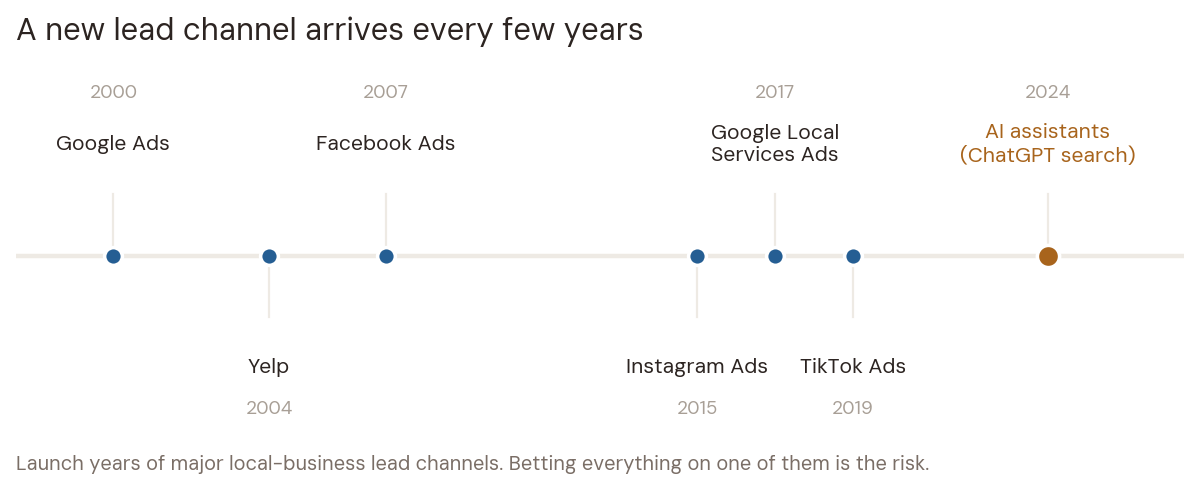
View the data behind this chart
| Year | Channel |
|---|---|
| 2000 | Google Ads (as AdWords) |
| 2004 | Yelp |
| 2007 | Facebook Ads |
| 2015 | Instagram Ads |
| 2017 | Google Local Services Ads |
| 2019 | TikTok Ads |
| 2024 | AI assistants (ChatGPT search) |
Download this chart as an image. Hover any data point above for details.
Every business has a different best channel, and you cannot know it in advance
Here is what years of running campaigns has shown us. An interior decorator can do very well on Instagram and poorly on Google. A tiny home community can do poorly on Facebook and very well on Google Search. A law firm usually lives and dies on high intent Google searches. And in some crowded service markets the cost per lead on Google is so high that the smarter play is a different channel entirely.
Nobody, including us, can reliably predict which of these you are before spending money. Anyone who promises otherwise is selling confidence, not evidence.
Why we fan out first
That is why we launch with what we call a fan out. A shotgun before a sniper rifle. Instead of betting everything on the one channel you walked in wanting, we test two or three channels at once under one flat omni price, with real tracking on every call and form. After 60 to 90 days the data tells us which channel earned the budget. Then we concentrate on what works and drop what does not.
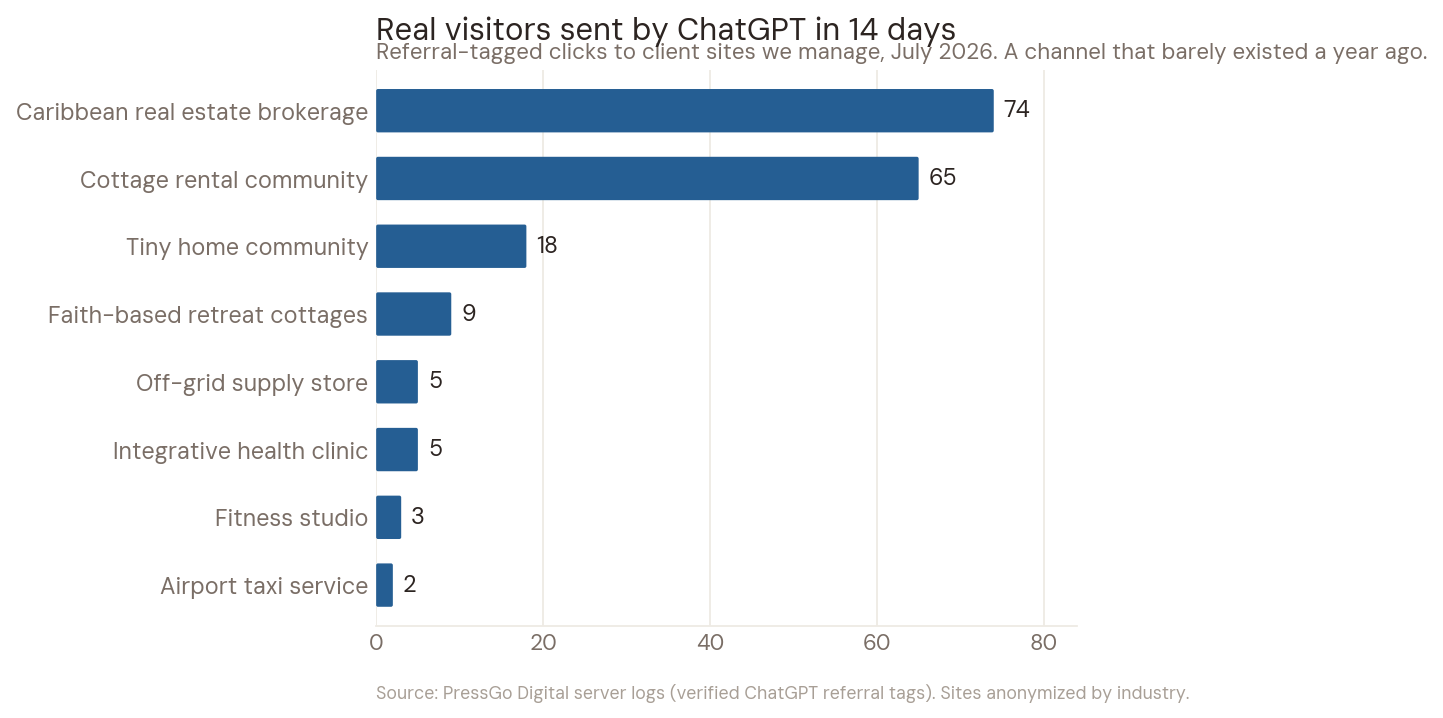
And underneath all of it, we build search visibility the whole time. SEO and AI search optimization remain the most underappreciated marketing workhorses there are. A growing share of our own clients tell us they found us on Google when it was actually ChatGPT that recommended us. The channels are multiplying again, which is one more reason not to marry a single one.
View the data behind this chart
| Client site (anonymized) | Sessions | AI sessions | Per 1,000 | AI sources seen |
|---|---|---|---|---|
| Caribbean real estate brokerage | 4,109 | 64 | 15.6 | chatgpt.com |
| Fitness studio | 139 | 2 | 14.4 (small sample) | chatgpt.com |
| Cottage rental community | 2,427 | 23 | 9.5 | chatgpt.com, copilot.com, gemini.google.com |
| Tiny home community | 2,088 | 14 | 6.7 | chatgpt.com, copilot.com |
Download this chart as an image. Hover any data point above for details.
Own everything, always
Key man risk is the same disease in a different body. If one employee holds all the knowledge of how your ads run, you have a single point of failure on payroll. If your agency holds your ad account, your analytics, and your website logins, you have a single point of failure on retainer. Why would you let another company own your marketing to the point where, if they raise prices or disappear, you cannot do anything about it?
This one is personal for us. Earlier in our history we depended on another company for part of our own fulfillment, and we learned the hard way that they could change the rules whenever they wanted. We will not air the details, but we came out of it with a rule we now apply to everything: own your strategy, own your accounts, own your data. It is also why everything we build for clients stays in their name. Your Google Ads account, your Business Profile, your website. If we ever part ways, it all stays with you.
If you are doing this yourself
You do not need an agency to apply any of this. Here is the honest checklist.
- Test two or three channels with small budgets instead of one channel with everything.
- Give each test 60 to 90 days and real tracking before you judge it.
- Keep every account in your own name. No exceptions, no matter who runs it day to day.
- Write down what worked and why, so the knowledge is not trapped in one head.
- Build SEO and AI search visibility in the background the entire time. It compounds while paid channels fluctuate.
We would rather teach you to run your own machine than keep you dependent on ours. The clients we work with longest are the ones who keep scaling and want a partner for it, not the ones who feel trapped. If you want us to look at your current mix and tell you where the risk is hiding, book a free consultation and we will walk through it with you.